

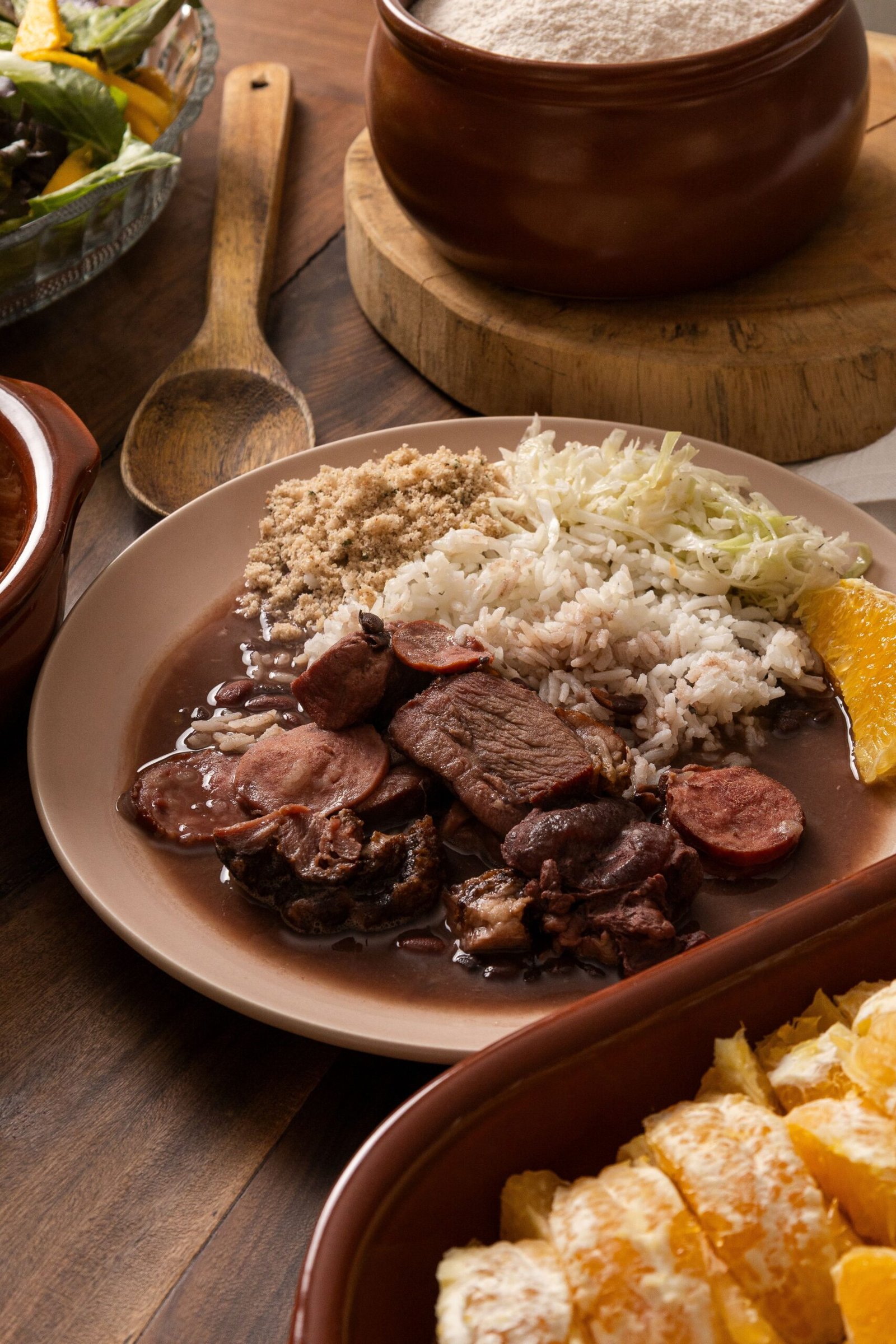
If you are looking for the best feijoada near me, you are looking for Brazil’s national dish: a slow-cooked black-bean stew, rich with pork, served with white rice, farofa, collard greens and orange slices. It is hearty, smoky and deeply comforting, and it is the kind of meal that turns an ordinary lunch into an occasion. This guide explains what feijoada is, what goes into it, what it is served with, where to find a good one near you, and how to cook it at home when you cannot find one.
What Is Feijoada?
Feijoada is a Brazilian stew made from black beans and pork, cooked slowly until the beans are creamy and the meat is tender. The name comes from feijao, the Portuguese word for beans. It is Brazil’s national dish, eaten across the whole country, and it is traditionally a leisurely weekend meal, often served on Wednesdays and Saturdays in restaurants, when friends and family gather for a long lunch.
A proper feijoada is not a quick dish. The beans and meats cook together for hours, and the flavours build slowly: the smokiness of the pork, the earthiness of the beans, and the salt of the sausages all melt into one rich stew. The dish is served in a bowl or a pot at the table, with the side dishes arranged around it, and everyone helps themselves. It is food for sharing, and it is meant to be eaten slowly, with conversation and a cold drink.
The best feijoada near me is usually found in a Brazilian restaurant, especially one that serves feijoada as a weekend special. Because the stew takes hours to cook, restaurants that make it properly only serve it on certain days, and that is a good sign: a feijoada on the menu every day, made in a hurry, is rarely a good one. A restaurant that only serves feijoada on set days is usually where you will find the best feijoada near me.
What Is Feijoada Made Of?
Feijoada is made of black beans and a mix of pork. The pork usually includes pork shoulder, smoked sausages, pork ribs and sometimes smoked pork belly or dried beef, depending on the region and the cook. The meats are the flavour of the dish: as they cook slowly in the beans, their fat and smoke season the whole pot. Garlic, onion and bay leaves are the main seasonings, and the stew is kept simple so the beans and pork can speak for themselves.
The beans are black beans, soaked overnight and then cooked with the meats until they are soft and creamy. The stew should be thick, not watery, with the beans holding their shape but soft enough to mash against the rice. Some cooks take a ladle of beans out at the end, mash them, and stir them back in to thicken the stew. That is a traditional trick, and it gives feijoada its creamy texture without any cream.
There is no single fixed recipe for feijoada, and every Brazilian family has its own version. Some use more sausage, some use more ribs, and some add smoked meats for extra depth. What matters is the slow cooking and the balance: enough pork to flavour the beans, but not so much that the beans disappear under the meat. That balance is what makes the best feijoada near me taste rich without being greasy.
What Is Feijoada Served With?
Feijoada is always served with the same side dishes, and they are part of the dish, not an afterthought. White rice is the base, and the stew is spooned over it. Farofa is toasted cassava flour, often cooked with a little butter, onion and sometimes bacon, and it is sprinkled over the stew for crunch. It soaks up the sauce and adds a nutty, toasty flavour.
Collard greens, called couve in Portuguese, are shredded finely and quickly fried with garlic and olive oil. They add a fresh, green bite that cuts through the richness of the stew. Orange slices are served alongside, and their sharp sweetness cleans the palate between spoonfuls. A little hot sauce is usually on the table too, and a caipirinha, Brazil’s lime and cachaca cocktail, is the classic drink with the meal.
Each side dish does a job: the rice soaks up the sauce, the farofa adds crunch, the greens add freshness, and the orange adds acidity. A feijoada served without them is incomplete, so if a restaurant serves the stew on its own with no sides, it is not a proper feijoada. When you search for the best feijoada near me, look for a place that serves the full spread.
Feijoada vs Chilli: What’s the Difference?
People often ask about feijoada vs chilli, because both are bean stews with meat, and both are served with rice. The difference is in the beans, the meat and the flavour. Chilli is made with kidney beans or pinto beans, ground beef or minced meat, tomatoes, chillies and cumin, and it is spicy and tomatoey. Feijoada is made with black beans, whole cuts of pork and sausage, no tomatoes, and no chilli heat in the stew itself.
Chilli is a Tex-Mex dish, built around dried chillies and cumin, and it is meant to be hot. Feijoada is Brazilian, built around smoked pork and slow cooking, and it is rich and smoky rather than spicy. The heat in a feijoada meal comes from the hot sauce on the table, not from the stew. Both are good, but they are different dishes, and a restaurant that calls a bean chilli a feijoada is getting it wrong. If you want the best feijoada near me, look for black beans and smoked pork, not kidney beans and tomatoes.
How to Find the Best Feijoada Near Me
Finding the best feijoada near me starts with Brazilian restaurants. Look for Brazilian restaurants, steakhouses and cafes, especially ones that list feijoada as a weekend special, usually on Wednesdays and Saturdays. A restaurant that cooks feijoada only on certain days is a good sign, because it means the stew is made properly, in a big pot, over several hours. Latin American food markets and Brazilian community events sometimes serve it too.
Ask two questions before you order. First, is the feijoada made in-house, and is it cooked slowly? Second, does it come with the full spread: white rice, farofa, collard greens and orange slices? If the answer to either question is no, keep looking. A feijoada served with only rice is not the real dish, and a feijoada that was made in an hour is not going to taste like one that cooked all morning.
Some Brazilian steakhouses include feijoada as part of a buffet or a weekend lunch, and that can be a good way to try it. If you live somewhere with no Brazilian restaurant at all, cooking the best feijoada near me at home is the best option, and the recipe below shows how.
How to Make Feijoada at Home
Making feijoada at home takes time, but most of it is waiting while the pot simmers. You need dried black beans, a mix of pork, and the side dishes.
Soak 500g of dried black beans overnight in cold water, then drain. In a large pot, fry a chopped onion and four garlic cloves in a little oil, then add the beans, about 500g of pork shoulder cut into chunks, two smoked sausages sliced, and a couple of pork ribs if you have them. Add two bay leaves, cover with water, and bring to a boil. Skim off any foam, then turn the heat down and simmer gently for two to two and a half hours, until the beans are soft and the meat is tender. Season with salt near the end, not at the start, because salt added early can keep the beans firm.
While the stew cooks, make the sides. Cook white rice as usual. For the farofa, fry a chopped onion in butter, add about 200g of cassava flour, and stir over medium heat until it is golden and toasty. For the greens, shred a bunch of collard greens or spring greens very finely and fry quickly with garlic and olive oil until just wilted. Serve the stew in a bowl with rice, farofa, greens and orange slices on the side, and hot sauce on the table. Cook it once at home and you will know what the best feijoada near me should taste like.
What to Drink with Feijoada
Feijoada is a rich, heavy meal, and the classic drink with it is a caipirinha: cachaca, lime, sugar and ice, muddled together. The sharp lime and the ice cut through the richness of the stew and refresh the palate. If you do not drink alcohol, a lime and soda does a similar job, and a cold lager works well too.
In Brazil, feijoada is a lunch dish, not a dinner dish, because it is so filling. It is eaten slowly, over a long afternoon, with plenty of conversation. If you are cooking it at home, plan for a lazy lunch rather than a quick supper, and make enough for seconds: feijoada tastes even better the next day, once the flavours have had a night to settle. A bowl of the best feijoada near me is a slow lunch, not a fast one, and the drink should be just as unhurried.
Common Mistakes to Avoid
The most common feijoada mistake is rushing it. The stew needs at least two hours of slow cooking for the beans to go creamy and the meat to turn tender. A feijoada cooked in an hour will have firm beans and tough meat, and it will not taste like the real dish. Give it time, and keep the heat low so the beans do not break apart.
The second mistake is adding salt too early. Salt added at the start can keep dried beans firm, so season the stew near the end of cooking, once the beans are soft. The third mistake is skipping the side dishes: feijoada without rice, farofa, greens and orange is only half a meal. And the fourth mistake is using only one kind of pork. The flavour of feijoada comes from the mix of meats, so use at least two or three different cuts, including something smoked, for depth.
How to Spot the Best Feijoada Near Me
When you are hunting for the best feijoada near me, a few signs tell you that you have found a good one. First, the timing: the best feijoada near me is served on a set day, usually a Wednesday or a Saturday, because it is cooked in a big pot over hours. Second, the sides: the best feijoada near me comes with white rice, farofa, collard greens and orange slices, not just rice. Third, the texture: the beans should be creamy and the meat tender, not firm or dry. Fourth, the flavour: you should taste the smoke of the pork and the earthiness of the beans, not just salt. A place that gets all four right is where you will find the best feijoada near me.
Frequently Asked Questions
What is feijoada made of?
Feijoada is made of black beans and a mix of pork, usually pork shoulder, smoked sausages, pork ribs and sometimes smoked pork belly. The beans are soaked overnight, then cooked slowly with the meats, garlic, onion and bay leaves until the beans are creamy and the meat is tender. It is served with white rice, farofa, collard greens and orange slices.
What do you serve with feijoada?
Feijoada is served with white rice, farofa (toasted cassava flour), collard greens fried with garlic, and orange slices. Hot sauce is usually on the table, and a caipirinha is the classic drink. Each side does a job: the rice soaks up the sauce, the farofa adds crunch, the greens add freshness, and the orange adds acidity.
Is feijoada gluten free?
Yes, feijoada itself is naturally gluten free, because it is made from beans, pork and vegetables with no flour or bread in the stew. The side dishes are usually gluten free too, although farofa should be checked, as some versions are made with wheat flour. If you are cooking at home, use cassava flour for the farofa to keep the whole meal gluten free.
How long does feijoada take to cook?
Feijoada takes about two to two and a half hours of slow cooking, after soaking the beans overnight. The beans and meats simmer gently until the beans are soft and creamy and the meat is tender. It cannot be rushed: a feijoada cooked in an hour will have firm beans and tough meat. Leftovers taste even better the next day.
Where can I find the best feijoada near me?
The best feijoada near me is usually found at Brazilian restaurants that serve it as a weekend special, often on Wednesdays and Saturdays. Look for a place that cooks it in-house over several hours and serves it with the full spread of rice, farofa, greens and orange. If there is no Brazilian restaurant near you, cooking it at home is a good option.
Is feijoada spicy?
No, feijoada is not spicy. The stew itself is rich and smoky rather than hot, and it contains no chillies. The heat in a feijoada meal comes from the hot sauce served on the table, which you add to your own taste. If you do not like heat, you can enjoy feijoada without any hot sauce at all. The best feijoada near me is rich and smoky, and the heat is always yours to add.
Can you make feijoada vegetarian?
Yes, you can make a vegetarian feijoada by leaving out the pork and cooking the black beans with smoked paprika, garlic, onion and bay leaves for depth. Smoked tofu or vegetarian sausages can add the smoky flavour the pork usually provides. It will not taste the same as the traditional version, but a well-seasoned vegetarian feijoada is a good dish in its own right.
What is feijoada completa?
Feijoada completa is the full feijoada meal: the black-bean and pork stew served with all of its traditional side dishes, white rice, farofa, collard greens, orange slices, and hot sauce on the table. The word completa means complete, and it is used to distinguish the full spread from the stew served on its own.
Whether you find the best feijoada near me at a Brazilian restaurant, a weekend lunch special or your own kitchen, the rule is the same: black beans, a good mix of pork, slow cooking, and the full spread of sides. Get those four right and the dish takes care of itself. For more recipes, food guides and kitchen ideas, visit Pulse Streams.
