

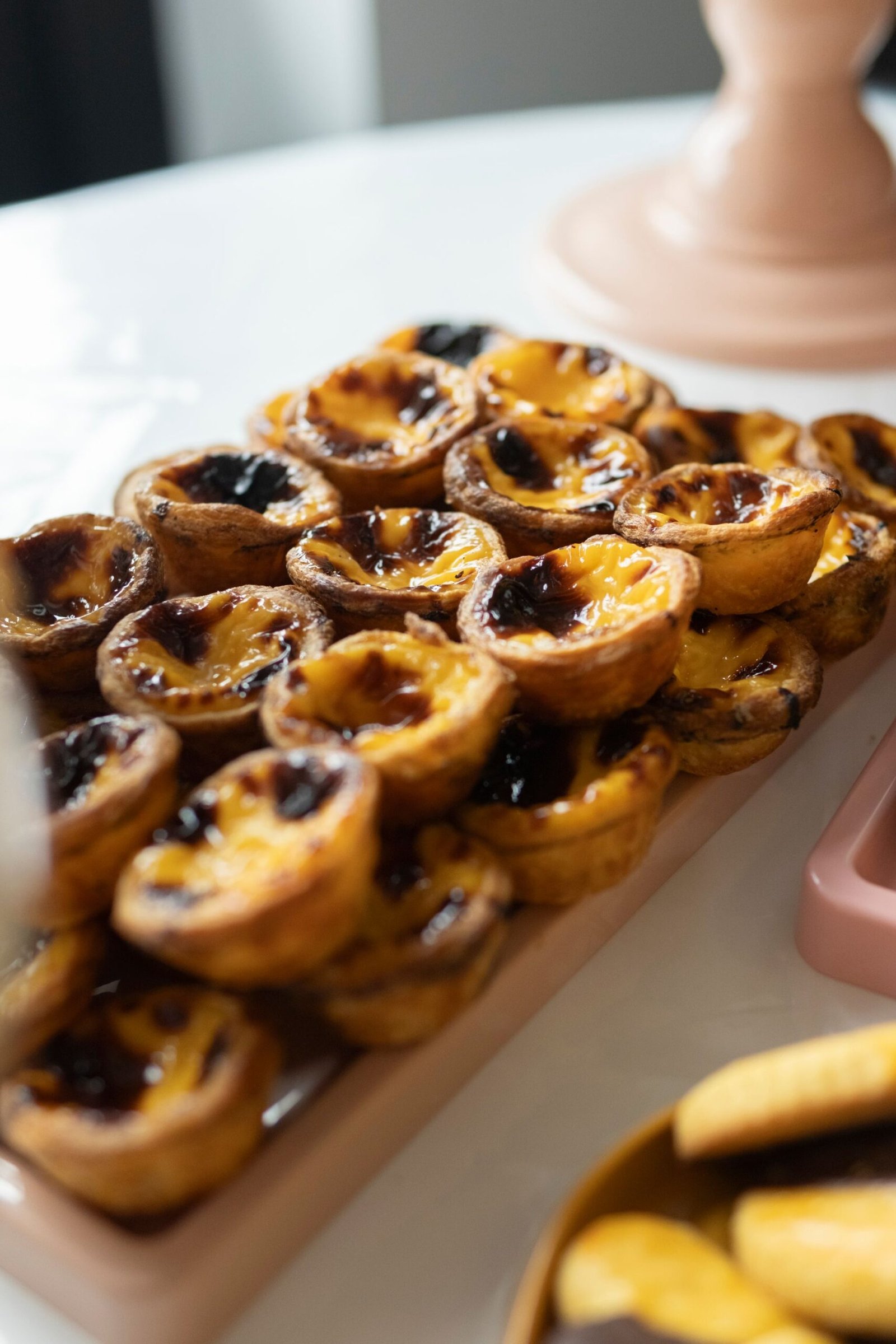
If you are looking for the best pastel de nata near me, you are looking for one of the world’s great pastries: a small Portuguese custard tart with crisp, flaky puff pastry and a warm, creamy egg-yolk custard, its top lightly caramelised and dusted with cinnamon. It is best eaten warm, with a coffee, and it is the kind of pastry that makes a bakery worth visiting. This guide explains what pastel de nata is, what goes into it, where to find a good one near you, and how to bake it at home when you cannot find one.
What Is Pastel de Nata?
Pastel de nata is a Portuguese custard tart, and it is Portugal’s most famous pastry. It is a small, round tart made from layers of thin, crisp puff pastry filled with a smooth custard of egg yolks, milk, sugar and a little cornflour. The top is baked until it blisters and caramelises in places, which gives it its signature look: golden custard with dark, almost burnt spots. Before eating, it is traditionally dusted with cinnamon and icing sugar.
The tart comes from Lisbon, where it was first made by monks at the Jeronimos Monastery. The monks had more egg yolks than they knew what to do with, because egg whites were used to starch clothes, and they turned the leftover yolks into custard tarts. When the monastery closed, the recipe was sold to a nearby bakery, and the tarts became famous across Portugal and then around the world. The bakery near the monastery still sells them today, and it is one of Lisbon’s best-known food stops. Back home, the best pastel de nata near me is the closest thing to that Lisbon original.
The best pastel de nata near me is usually found in a Portuguese bakery or cafe, especially one that bakes its tarts fresh through the day. Because the pastry goes soft as it cools, a good pastel de nata is eaten warm, within an hour or two of baking, which is why the best bakeries bake small batches all day rather than one big batch in the morning.
What Is Pastel de Nata Made Of?
A pastel de nata has only a few ingredients, and each one matters. The pastry is puff pastry, rolled very thin and pressed into small tart tins so it forms a crisp shell with many flaky layers. The custard is made from egg yolks, milk, sugar and a little cornflour to help it set, flavoured with vanilla and a strip of lemon peel. Some recipes add a little cinnamon to the custard itself, but the classic dusting goes on top at serving time.
There is no cream in the custard, despite the name “custard tart”. The filling is an egg-yolk custard made with milk, not cream, which is why it sets firm but stays smooth and silky. The top of the tart is baked at a very high temperature so it blisters and caramelises, and those dark spots are not a mistake: they are the sign of a properly baked pastel de nata, and they add a gentle bitter note that balances the sweetness.
Good puff pastry is the hardest part of the tart. The layers must be thin and crisp, shattering when you bite, not soft and doughy. That is why the best pastel de nata near me comes from a bakery that makes its own pastry or buys good quality puff pastry and bakes it properly, rather than one that uses a soft, underbaked shell.
Pastel de Nata vs Egg Tart: What’s the Difference?
People often ask about pastel de nata vs egg tart, because the two look similar and both are custard tarts in puff pastry. The difference is in the details. A Portuguese pastel de nata is baked at a very high temperature, so the custard blisters and caramelises on top and the pastry goes very crisp. It is flavoured with cinnamon and lemon, and it is served warm with cinnamon and icing sugar on top.
The Hong Kong egg tart, which most people mean when they say “egg tart”, is baked more gently, so the custard stays smooth and pale yellow with no blistering, and the pastry is often a shortcrust or a softer puff pastry. It is less sweet, with no cinnamon, and it is usually eaten at room temperature. Both are good, but they are different pastries, and a bakery that sells one may not sell the other. If a bakery sells both, order the best pastel de nata near me and the egg tart side by side to taste the difference.
There is also the question of pastel de nata vs pastel de Belem. Pastel de Belem is the original tart from the bakery near the Jeronimos Monastery in Lisbon, made to the monastery’s original recipe, which the bakery keeps secret. Every other pastel de nata is a version of the same tart made to a slightly different recipe. In practice, a well-made pastel de nata anywhere tastes very close to the original, and the name on the box matters less than how fresh and crisp the tart is.
How to Find the Best Pastel de Nata Near Me
Finding the best pastel de nata near me starts with Portuguese bakeries and cafes. Look for Portuguese delis, bakeries and coffee shops, especially ones that bake on the premises and list pastel de nata as a house speciality. Some Portuguese restaurants serve them as a dessert, and food markets sometimes have a Portuguese stall with fresh tarts. A bakery that bakes several small batches a day is a better bet than one that bakes once in the morning, because a pastel de nata is at its best warm and fresh.
Ask two questions before you buy. First, when were these baked? A tart baked within the last hour or two will have crisp pastry and a warm, silky custard. A tart from this morning will still taste good, but the pastry will have softened. Second, are they warmed before serving? A good bakery will warm a cooled tart briefly before handing it over, which brings the pastry back to life.
Supermarkets sometimes stock pastel de nata, and some are surprisingly decent, but they rarely match a fresh bakery tart. Supermarket tarts are baked in bulk and shipped, so the pastry is usually softer and the custard cooler. If you cannot find a Portuguese bakery near you, making the best pastel de nata near me at home is a better option than a supermarket pack, and the method below shows how.
How to Make Pastel de Nata at Home
Making pastel de nata at home is very doable, and it is the best option when you cannot find the best pastel de nata near me locally. You need good puff pastry, egg yolks, milk, sugar and a very hot oven.
Start with the custard. Warm about 250ml of milk with a strip of lemon peel and a vanilla pod or a teaspoon of vanilla extract, then take it off the heat and let it cool slightly. Whisk six egg yolks with about 150g of caster sugar and two tablespoons of cornflour until smooth, then slowly whisk in the warm milk. Strain the mixture into a jug and set it aside.
Roll out a sheet of all-butter puff pastry as thin as you can and cut it into squares, then press each square into a muffin tin so the pastry lines the cups, trimming the tops. Fill each cup about three quarters full with custard. Bake at the highest temperature your oven allows, around 250°C if it can, for 10 to 12 minutes, until the pastry is crisp and golden and the custard has blistered on top. Let the tarts cool for a few minutes in the tin, then lift them out and serve warm, dusted with cinnamon and icing sugar. Once you have baked a batch at home, you will know what the best pastel de nata near me should taste like.
How to Eat Pastel de Nata
A pastel de nata is eaten warm, with your hands, and it takes about three bites. Hold it by the pastry edge, dust the top with cinnamon and icing sugar if it is not already done, and bite through the crisp shell into the warm custard. The contrast is the whole point: crisp pastry against soft custard, sweet custard against the slight bitterness of the caramelised top.
In Portugal, a pastel de nata is almost always eaten with coffee, usually a small strong espresso. The coffee cuts through the sweetness and makes the tart taste richer. If you are having one at home, a strong black coffee or a flat white works just as well. Some people eat them for breakfast, some as an afternoon snack, and some as a dessert after dinner. There is no wrong time: a fresh pastel de nata is good whenever it is warm. A warm slice of the best pastel de nata near me with a coffee is one of the simplest pleasures in food.
If your tarts have gone cold, warm them in a hot oven for a few minutes before eating. A microwave will soften the pastry and spoil the crispness, so the oven is the better choice. Eat them the same day they are baked, because the pastry softens overnight and the custard loses its fresh flavour.
Common Mistakes to Avoid
The most common pastel de nata mistake is baking at too low a temperature. The tart needs a very hot oven so the pastry crisps and the custard blisters on top. A cool oven gives you a pale, soft tart with a rubbery custard, which is not a pastel de nata at all. Turn your oven up as high as it goes and use the top shelf.
The second mistake is under-filling or over-filling the pastry cases. Too little custard and the tart is mostly pastry; too much and it spills over and burns. Fill each case about three quarters full. The third mistake is using poor quality puff pastry, or pastry that is too thick. Roll it thin, so the layers can crisp properly. And the fourth mistake is eating the tart cold when it should be warm: a pastel de nata straight from the fridge is a different, lesser thing than one eaten warm from the oven. Warmth is what makes the best pastel de nata near me worth the trip.
How to Spot the Best Pastel de Nata Near Me
When you are hunting for the best pastel de nata near me, a few signs tell you that you have found a good one. First, the pastry: the best pastel de nata near me has a crisp, flaky shell that shatters when you bite it, not a soft or doughy one. Second, the top: the custard should be golden with dark caramelised blisters, not pale and flat. Third, the temperature: it should be warm, or warmed before serving, because a cold tart has lost its best quality. Fourth, the bakery: a Portuguese bakery that bakes small batches through the day is where you will find the best pastel de nata near me, not a shop selling day-old tarts from a shelf.
Frequently Asked Questions
What is pastel de nata made of?
Pastel de nata is made of thin, crisp puff pastry filled with an egg-yolk custard of egg yolks, milk, sugar and a little cornflour, flavoured with vanilla and lemon. There is no cream in the custard. The top is baked until it blisters and caramelises, and the tart is traditionally dusted with cinnamon and icing sugar before eating.
Is there cream in pastel de nata?
No, there is no cream in pastel de nata, even though it is often called a custard tart. The filling is an egg-yolk custard made with milk, not cream. The custard sets firm but stays smooth and silky, and it is the egg yolks that give it its rich golden colour.
Where is pastel de nata from?
Pastel de nata comes from Lisbon, Portugal, where it was first made by monks at the Jeronimos Monastery. The monks used leftover egg yolks to make custard tarts, and when the monastery closed, the recipe was sold to a nearby bakery. The bakery still sells the original tarts today, and pastel de nata is now Portugal’s most famous pastry.
How much does a pastel de nata cost?
The price of a pastel de nata depends on the bakery and the city. In the UK they are usually sold singly, and prices vary from one bakery to another. A Portuguese bakery that bakes them fresh will usually charge more than a supermarket, and the extra cost is worth it for a warm, crisp tart.
What is the difference between pastel de nata and pastel de Belem?
Pastel de Belem is the original tart from the bakery near the Jeronimos Monastery in Lisbon, made to the monastery’s original recipe, which the bakery keeps secret. Every other pastel de nata is a version of the same tart made to a slightly different recipe. A well-made pastel de nata anywhere tastes very close to the original.
Where can I find the best pastel de nata near me?
The best pastel de nata near me is usually found at Portuguese bakeries and cafes that bake on the premises, especially ones that bake small batches through the day. Look for a bakery that sells them warm and fresh, with crisp pastry and a blistered custard top. If there is no Portuguese bakery near you, baking them at home is a good option.
How do you eat pastel de nata?
A pastel de nata is eaten warm, with your hands, dusted with cinnamon and icing sugar. Hold it by the pastry edge and bite through the crisp shell into the warm custard. In Portugal it is usually eaten with a small strong coffee. If your tarts have gone cold, warm them in a hot oven for a few minutes, not in a microwave. That is how the best pastel de nata near me is always served: warm, crisp and dusted with cinnamon.
Can you freeze pastel de nata?
Pastel de nata does not freeze well once baked, because the puff pastry loses its crispness when thawed. It is best eaten the same day it is baked. You can freeze unbaked tarts, pastry and custard already in the tins, and bake them straight from frozen, adding a few extra minutes to the baking time.
Whether you find the best pastel de nata near me at a Portuguese bakery, a food market or your own oven, the rule is the same: thin crisp pastry, a silky egg-yolk custard, and a very hot oven. Get those three right and the tart takes care of itself. For more recipes, food guides and kitchen ideas, visit Pulse Streams.
